Speech Clarity Support for Children
If your child is difficult to understand, struggles to say certain sounds, or their speech seems unclear for their age, speech therapy can help with speech and sound development.
At Pelorus OT, our Speech Pathologists support children to develop clear, confident speech so they can be understood at home, school, and in the community.
What is Speech and Sound Development?
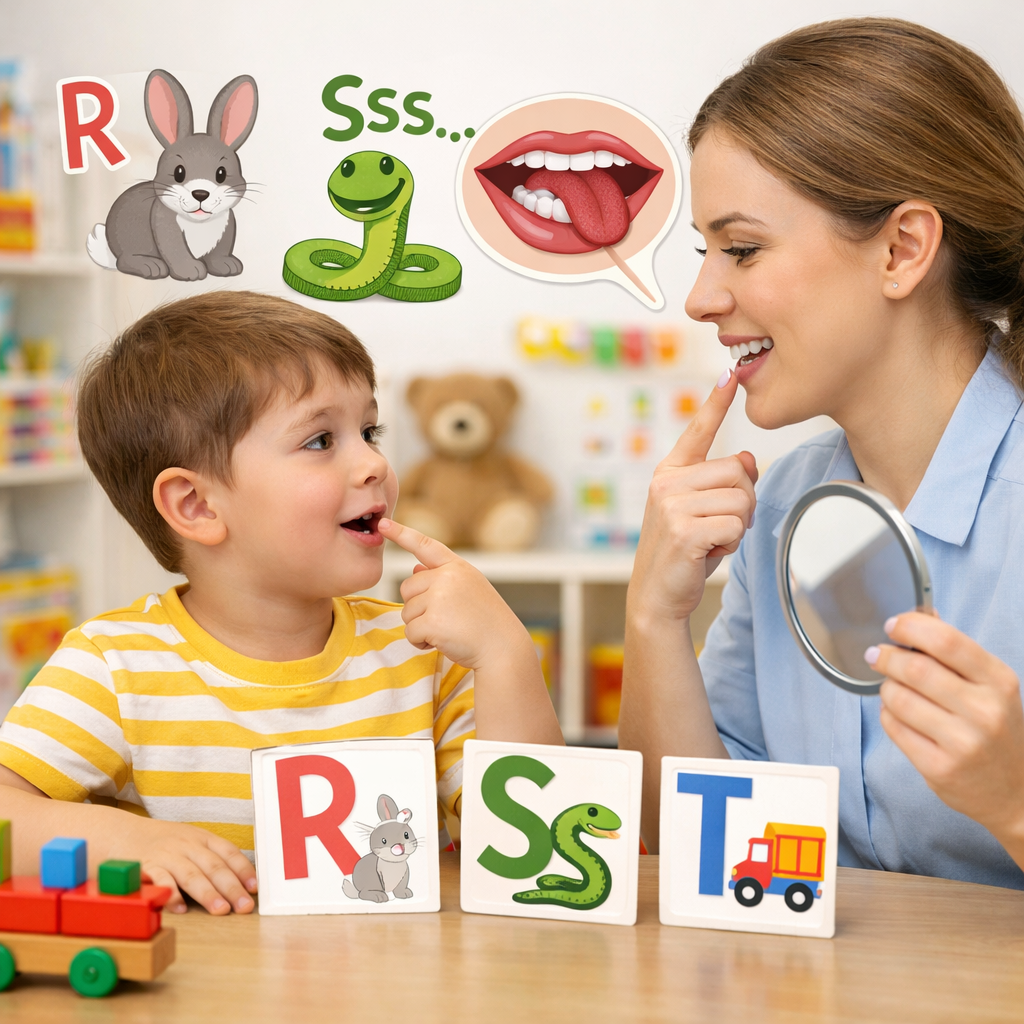
Speech and sound development refers to how children learn to produce speech sounds clearly.
Some children may experience:
- Difficulty saying certain sounds (e.g. “wabbit” instead of “rabbit”)
- Speech that is unclear to unfamiliar listeners
- Simplifying words or leaving out sounds
Clinically, this may relate to:
- Speech sound disorders
- Articulation difficulties
- Phonological processing differences
Signs Your Child May Need Support
Every child develops speech at their own pace, but there are some common signs that extra support in speech and sound development may be helpful.
You might notice that strangers or even extended family members find your child difficult to understand, especially as they get older. While younger children may naturally have unclear speech, it should gradually become easier to understand over time.
Some children become frustrated when speaking because they are not being understood. This may show up as repeating themselves frequently, giving up mid-sentence, or becoming upset during conversations.
You may also notice your child avoiding talking altogether, using fewer words than expected, or relying on gestures instead of speech. In some cases, children may resist repeating words or practicing sounds, particularly if they have had negative communication experiences.
If your child’s speech is not improving with age, or progress seems slower compared to peers, it may be a sign that additional support in speech and sound development could help build their skills and confidence.
Common signs include:
- Speech that is difficult for unfamiliar people to understand
- Frustration when trying to communicate
- Avoiding talking or reluctance to repeat words
- Leaving out sounds or simplifying words
- Speech not improving or developing as expected
How Speech Therapy Helps
Our Speech Pathologists use evidence-based, play-based approaches to support your child’s speech and sound development in a way that feels engaging and achievable.
We work on improving sound production and clarity by helping children learn how to correctly produce specific sounds, understand sound patterns, and use them consistently in everyday speech.
Therapy also focuses on building your child’s confidence. As children begin to feel understood, they are more likely to participate in conversations, try new words, and express themselves more freely.
We also support participation across environments, including home, kinder, and school. This ensures that your child can use their communication skills in real-life situations, not just in therapy sessions.
Importantly, therapy is never “one-size-fits-all.” Every session is tailored to your child’s strengths, interests, and communication style. We incorporate their favourite activities, play preferences, and goals to create a supportive and motivating environment.
In therapy, we focus on:
- Improving speech clarity and sound production
- Teaching correct sound patterns and word structures
- Building confidence in speaking and communication
- Supporting participation at home, kinder, and school
- Providing strategies for parents to use at home
Why Early Support Matters
Clear and effective communication is a key foundation for a child’s overall development.
When children are able to express their needs, thoughts, and ideas, they experience less frustration and greater independence in daily life. This can positively impact their emotional wellbeing and confidence.
Strong speech and sound development skills also support social development. Children who can communicate clearly are better able to build friendships, engage in play, and connect with others.
In learning environments, clear speech helps children participate in classroom activities, ask questions, and demonstrate their knowledge. This plays an important role in school readiness and ongoing academic success.
Early support can make a significant difference. By addressing speech challenges early, we can help prevent difficulties from becoming more complex over time and support your child to develop strong, lifelong communication skills.
Parent Tips for Supporting Speech at Home
A helpful speech and sound development milestone chart shows how children typically develop sounds by age—for example, early sounds like /p, b, m/ appear around 2–3 years, while later sounds like /r, /l, “sh,” and “th” may develop by 5–7 years. It is also important to understand the difference between articulation disorders (difficulty physically producing specific sounds) and phonological disorders (patterns of sound errors, such as saying “tat” for “cat”) within speech and sound development. Parents can support speech at home by talking slowly and clearly, reading daily, modeling correct word pronunciation without pressure, and encouraging repetition through play-based interaction.