
Supporting Housing Needs and Independence – Melbourne & Adelaide
At Pelorus OT, we provide Specialist Disability Accommodation (SDA) Assessments to support individuals who may require housing designed for higher support needs.
SDA is an NDIS-funded support for individuals who require specific housing design features due to significant functional impairment or very high support needs.
Our AHPRA registered occupational therapists conduct comprehensive, evidence-informed SDA assessments across Melbourne and Adelaide, focusing on how the home environment can better support safety, independence, and participation in everyday life.
What is a Specialist Disability Accommodation (SDA) Assessment?
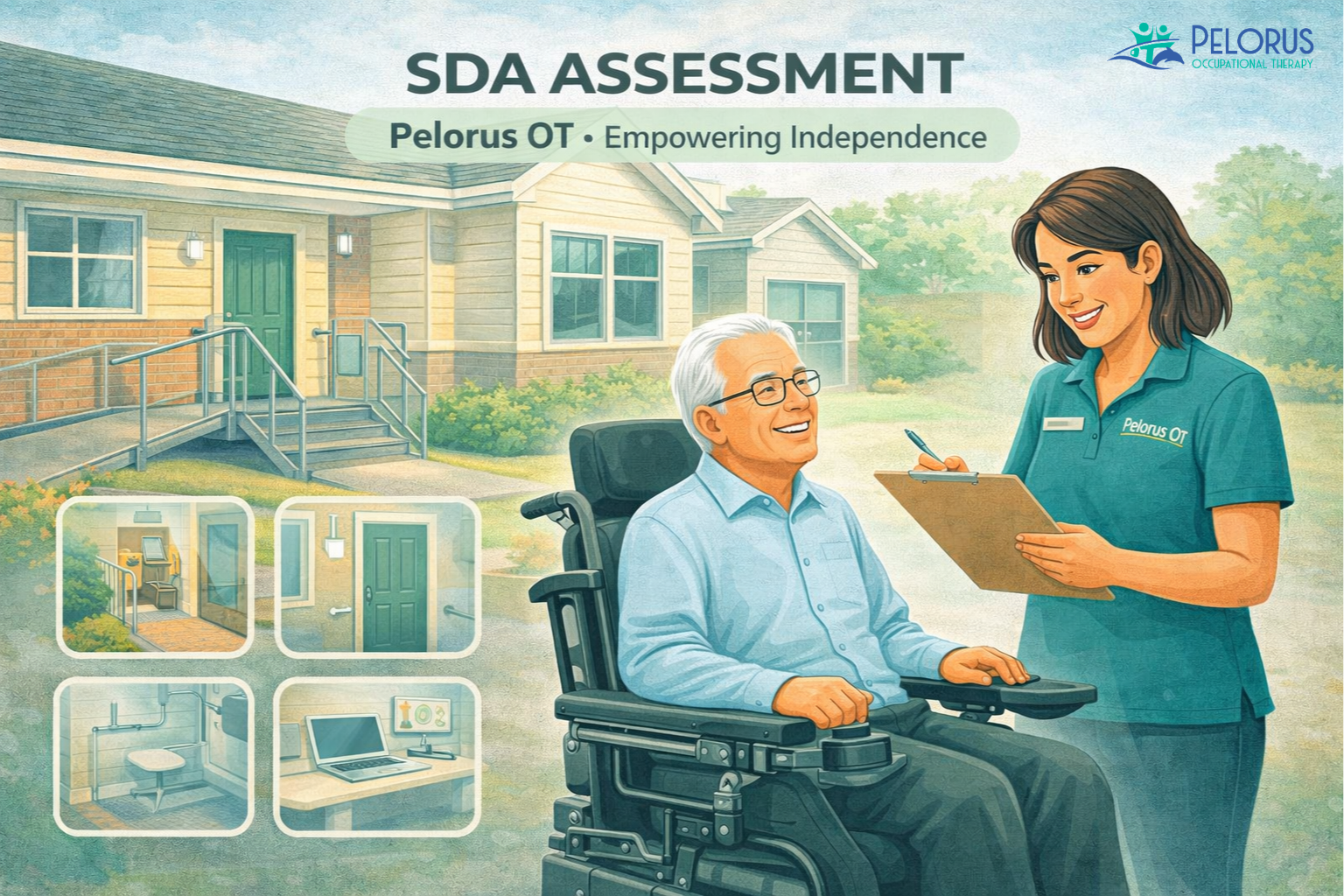
A Specialist Disability Accommodation (SDA) Assessment is a comprehensive Occupational Therapy assessment used to evaluate whether a participant may require specialist housing under the NDIS.
The purpose of an SDA assessment is to:
- Understand the individual’s functional capacity and housing needs
- Identify whether the current home environment creates barriers to safety, independence, or support delivery
- Determine whether specialist housing design features may be appropriate
- Provide evidence-based recommendations to support NDIS funding decisions
Specialist Disability Accommodation assessments consider both the individual’s support needs and how their environment impacts their ability to live safely and independently.
What is Specialist Disability Accommodation (SDA)?
Specialist Disability Accommodation is housing designed for individuals who require a higher level of accessibility, support, or environmental design due to their disability-related needs.
SDA may include:
- Improved physical access throughout the home
- Accessible bathrooms, kitchens, and entryways
- Structural features that support mobility and transfers
- Space for assistive technology and support staff
- Design features that improve safety and reduce risk
The goal of SDA is to provide a living environment that supports independence, safety, and long-term wellbeing.
What is Covered in an SDA Assessment?
Our SDA assessments follow a structured approach similar to a Functional Capacity Assessment and SIL Assessment, with additional focus on housing eligibility and design requirements.
Background and Participant Overview
We gather detailed information about the participant’s history, diagnosis, current supports, and living arrangements.
NDIS Goals and Housing Context
We review the participant’s goals and ensure that recommendations align with long-term independence and living outcomes.
Functional Capacity
We assess how the individual manages everyday activities, including:
- Personal care and hygiene
- Transfers and mobility
- Access within the home
- Meal preparation and daily routines
- Community access
Environmental and Housing Barriers
We assess whether the current home presents barriers such as:
- Limited accessibility
- Unsafe layouts or environments
- Inadequate space for equipment or supports
- Challenges for safe delivery of care
Eligibility for SDA
A key component of the SDA assessment is determining whether the participant may meet the NDIS eligibility criteria for Specialist Disability Accommodation.
This includes assessing:
- The extent of functional impairment
- The level of support required for daily living
- Risks associated with the current living environment
- Whether alternative supports (e.g., home modifications or assistive technology) would be sufficient
Our report provides detailed justification aligned with relevant NDIS guidelines to support consideration for SDA funding.
SDA Design Type and Design Features
Where SDA may be appropriate, we provide recommendations regarding suitable Specialist Disability Accommodation (SDA) design categories, which may include:
- Improved Liveability
- Fully Accessible
- Robust
- High Physical Support
We also outline recommended design features based on the participant’s needs, such as:
- Accessible bathrooms and kitchens
- Ceiling hoists or transfer systems
- Wider doorways and circulation space
- Reinforced structures or safety features
- Environmental controls or assistive technology integration
These recommendations ensure that the living environment is aligned with both current and future needs.
Roster of Care / Support Needs
Similar to SIL assessments, we outline the participant’s support requirements within the home environment, including:
- Level of supervision required
- Active vs passive supports
- Overnight support needs
- Frequency and duration of supports
This helps ensure that both the housing environment and support structure are considered together.
Summary and Recommendations
The report includes clear, structured, and evidence-informed recommendations, including:
- SDA eligibility justification
- Recommended housing design type
- Key environmental features required
- Support needs and considerations
Our SDA Assessment Process
At Pelorus OT, we follow a structured and transparent process, including support and guidance related to specialist disability accommodation, to ensure high-quality outcomes.
1. Initial Consultation
We begin with a detailed discussion to understand:
- Current living situation
- Daily challenges and support needs
- Participant goals and preferences
- Input from family and support networks
2. Functional and Environmental Assessment
We assess how the participant functions within their current environment and identify barriers to independence and safety.
3. Review of Supports and Equipment
We consider current supports, assistive technology, and home modifications, and how these impact the participant’s living situation.
4. Analysis of Housing Needs
We identify the housing requirements and environmental supports needed to improve safety, accessibility, and independence.
5. Draft Report Preparation
We prepare a detailed SDA assessment report outlining findings, analysis, and recommendations.
6. Internal Clinical Review
All SDA reports are reviewed by a senior or Head Occupational Therapist to ensure quality and consistency.
7. Release of Draft and Final Report
The draft report is shared for factual clarification. The final signed report is released upon completion of administrative requirements.
Important Considerations
SDA assessments are detailed and often form part of a broader housing and support planning process.
We encourage participants and families to approach this process with patience, as thorough assessments lead to more accurate recommendations and better long-term outcomes.
While we provide comprehensive assessments and well-supported recommendations, similar to Supported Independent Living (SIL) assessment, final funding decisions are made by the NDIS or relevant funding body, and outcomes depend on their individual criteria and processes.
Our Approach
At Pelorus OT, we take a person-centred and neuro-affirming approach to SDA assessments.
We focus on understanding the participant’s strengths, preferences, and support needs, ensuring recommendations are practical, respectful, and aligned with real-life participation.
Why Choose Pelorus OT for SDA Assessments?
- AHPRA registered occupational therapists
- Structured and detailed SDA reports
- Strong understanding of NDIS housing pathways
- Focus on functional outcomes and independence
- Internal quality review by senior clinicians
- Services available across Melbourne and Adelaide
If you are looking for a Specialist Disability Accommodation (SDA) Assessment in Melbourne or Adelaide, our team at Pelorus OT is here to help.
We provide clear, comprehensive assessments that support housing planning, funding applications, and long-term independence.