Reading, Writing & Communication Skills
Speech Pathologists play an important role in supporting children’s literacy and learning skills, particularly the communication foundations that underpin reading and writing. Strong Literacy and Learning development is closely linked to how children process language, understand instructions, and express themselves.
If your child is finding reading, spelling, or understanding language challenging, early and supportive intervention can help them build skills in a way that aligns with their strengths and learning style.
We take a neuro-affirming approach, recognising that children learn in different ways and at different paces. Our goal is to support each child to access learning in a way that works for them.
What is Literacy Support?
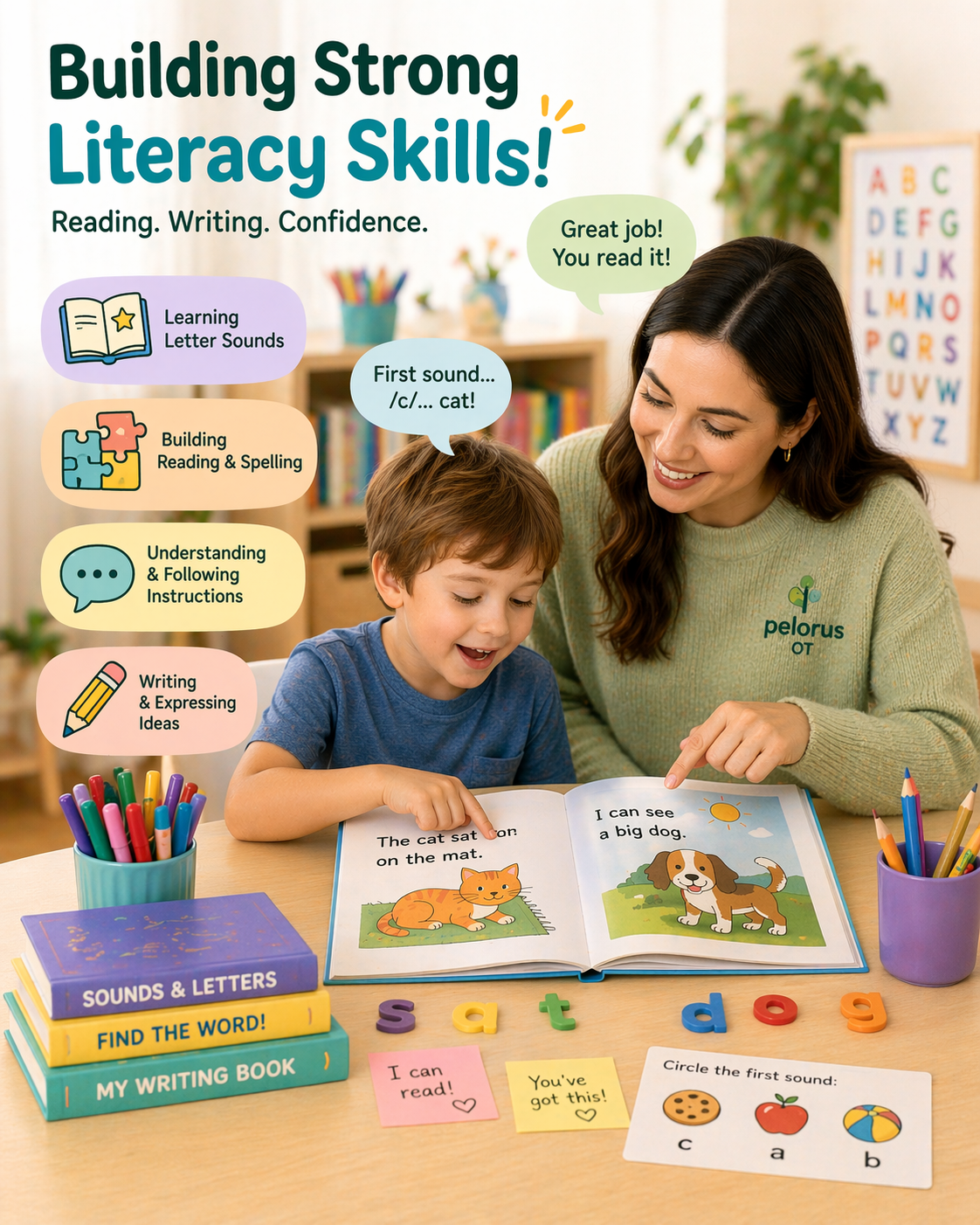
Literacy is more than just reading and writing. It involves a range of underlying communication skills that help children understand and use language in meaningful ways, forming the foundation for strong literacy and learning outcomes.
Speech Pathologists focus on the building blocks that support literacy development, including:
- Phonological awareness – understanding and playing with sounds in words (e.g. rhyming, identifying first sounds)
- Letter–sound knowledge – connecting sounds to written letters
- Reading comprehension – understanding the meaning of what is read
- Written expression – organising and expressing ideas through writing
These skills develop over time and are closely linked to a child’s language abilities, attention, and learning experiences.
Signs Your Child May Need Support
Children may experience challenges in literacy and learning for different reasons, and these can look different across ages and settings.
You might notice your child becoming frustrated with reading or writing tasks, avoiding literacy-based activities, or finding it difficult to keep up with classroom demands.
Common signs include:
- Difficulty learning or remembering letter sounds
- Challenges with reading accuracy or fluency
- Struggles with spelling or writing words
- Difficulty understanding what they read
- Trouble following instructions or processing information
- Avoiding reading, writing, or learning tasks
How Speech Therapy Helps
Speech therapy supports the underlying communication skills that are essential for Literacy and Learning development.
Our therapists use evidence-based, engaging approaches to help children build these skills in a way that feels achievable and meaningful.
We support children to:
- Develop phonological awareness and sound skills
- Strengthen early reading and spelling abilities
- Improve listening, attention, and comprehension
- Build confidence in engaging with literacy tasks
- Use language to organise and express ideas
We also work closely with families and educators to provide practical strategies that can be used across home and learning environments.
Therapy is always individualised, taking into account your child’s strengths, interests, and preferred ways of learning.
Why Literacy Skills Matter
Literacy skills are a key part of literacy and learning, helping children access learning, communicate ideas, and participate in everyday activities.
When children feel supported in their literacy development, they are more likely to engage with learning in a positive and confident way. Speech and literacy are closely linked because both depend on understanding and using language sounds. A key skill in this process is phonological awareness—the ability to recognise and work with sounds in spoken words, such as syllables, rhymes, and phonemes. This skill is essential for reading, as children need to connect sounds with letters to decode words. Strong phonological awareness supports reading development, while weaknesses can lead to reading difficulties. School-age children can be supported through activities like rhyming games, sound blending, segmenting words, and guided reading practice to strengthen this connection between speech and literacy.
Strong literacy skills support:
- Participation in learning environments
- Understanding and expressing ideas
- Confidence in reading and writing tasks
- Problem-solving and critical thinking
- Independence in everyday activities
Early support can help children build strong foundations in literacy and learning while also reducing frustration and supporting a positive relationship with learning over time.