Helping children speak with confidence, ease, and authenticity
Every child communicates in their own unique way, including how smoothly they speak and how their voice sounds.
Some children may experience differences in fluency (the flow of speech) or voice (how their voice sounds), such as stuttering, speaking very quickly, or having a hoarse or strained voice. These differences can sometimes make communication feel effortful or frustrating.
At Pelorus OT, we provide supportive, neuro-affirming speech therapy that focuses on confidence, comfort, and communication; rather than perfection.
What is Fluency and Voice?
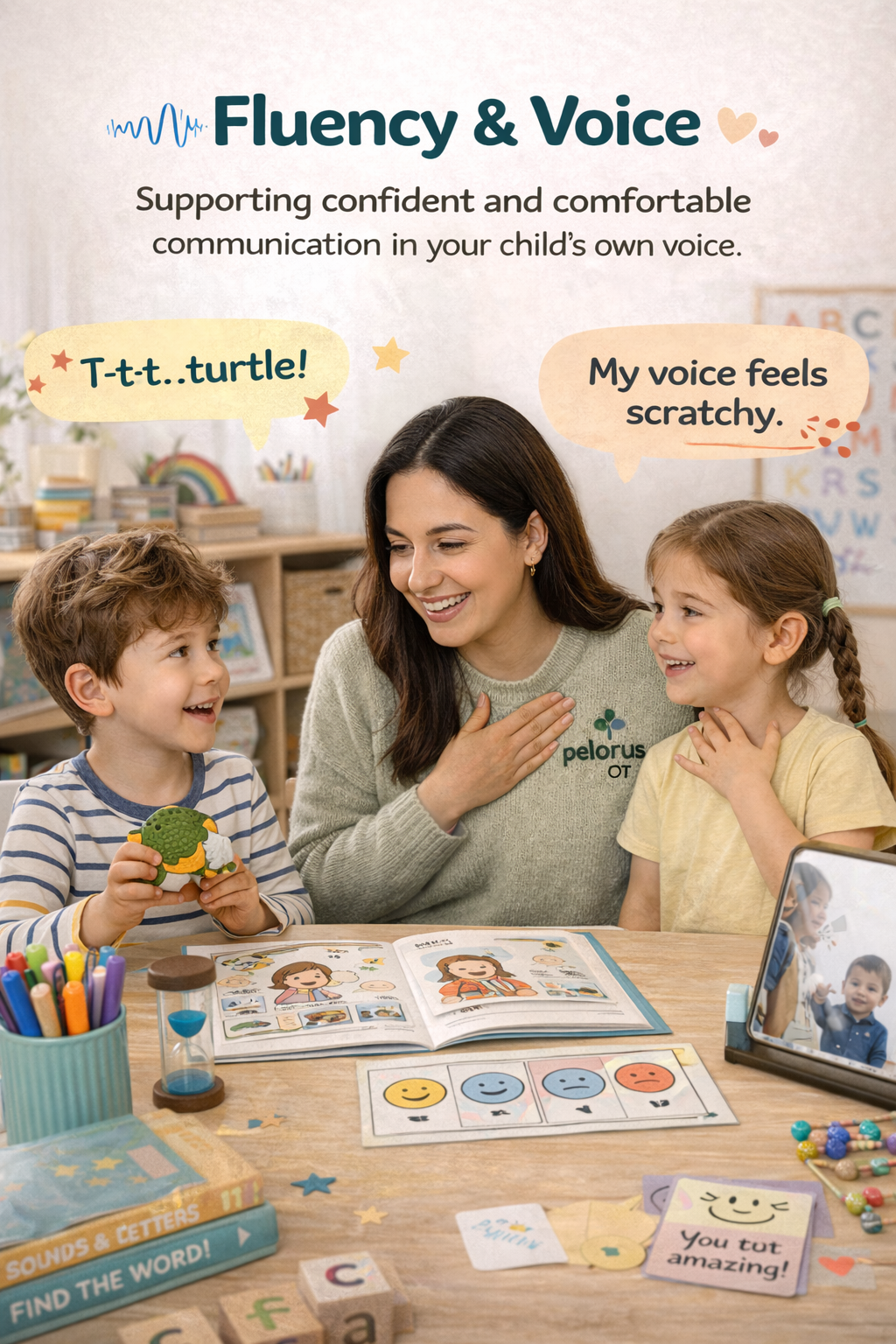
Fluency refers to the natural flow and rhythm of speech, how smoothly words are expressed. It’s common for all children to have moments of pausing, repeating, or hesitating as they develop their communication skills.
Voice refers to how speech sounds, including qualities such as pitch (high or low), volume (loud or soft), tone, and clarity. A child’s voice can vary depending on their environment, energy levels, and how they are using it.
Children may experience a range of fluency or voice differences, including:
- Stuttering (or stammering) – repeating sounds, words, or getting “stuck” when speaking
- Cluttering – speaking very quickly or with an irregular rhythm
- Voice differences – such as hoarseness, strain, breathiness, or vocal fatigue
These differences are common and may change depending on the situation or level of comfort. We view them as differences in communication, and support children to communicate with greater ease and confidence.
Signs Your Child May Benefit from Support
Some children may benefit from support when speaking feels effortful, unpredictable, or tiring, or when their voice is under strain.
You might notice your child becoming more aware of their speech, avoiding certain words or situations, or feeling frustrated when communicating.
Your child may:
- Repeat sounds, words, or phrases when speaking
- Get “stuck” or pause unexpectedly during speech
- Speak very quickly or with an uneven rhythm
- Show signs of tension when talking (e.g. facial or body tension)
- Have a hoarse, breathy, or strained voice
- Experience vocal fatigue or discomfort when speaking
- Avoid speaking in certain situations or around certain people
These experiences don’t mean something is “wrong”, they simply indicate that your child may benefit from support to make communication feel more comfortable and sustainable.
How Speech Therapy Helps
Our Speech Pathologists support children to develop communication strategies that feel natural, flexible, and suited to their individual needs.
We take a strengths-based, neuro-affirming approach, recognising that there is no single “right” way to speak. Instead of focusing on eliminating differences, we support children to communicate with greater ease, confidence, and control.
We support children to:
- Develop smoother and more comfortable speech patterns
- Explore strategies that support ease of communication
- Build confidence in expressing themselves
- Use their voice in ways that are safe and sustainable
- Reduce physical tension or effort during speech
We also work closely with families to create supportive communication environments that reduce pressure and support positive speaking experiences.
Our Approach
At Pelorus OT, we prioritise creating a safe and supportive space where children feel comfortable communicating in their own way.
We understand that pressure to “speak perfectly” can increase anxiety and make communication more difficult. Instead, we focus on building confidence, reducing stress, and supporting participation.
Our approach focuses on:
- Reducing communication pressure and time demands
- Supporting confidence and self-expression
- Encouraging positive and meaningful communication experiences
- Working collaboratively with families and environments
- Respecting each child’s communication style and pace
Our goal is to support children to communicate in ways that feel authentic, comfortable, and empowering.