Finding the right communication system and supporting confident use in everyday life
Everyone has a right to communicate in ways that work for them.
For some individuals, speech may not be the most effective or preferred way to express themselves. An AAC Assessment helps identify the most suitable communication methods, ensuring the right support is in place. Augmentative and Alternative Communication (AAC) provides additional ways to communicate, supporting participation, independence, and connection.
At Pelorus OT, we offer AAC Assessment, Prescription, and Training for both children and adults. Our focus is on understanding each person’s communication style, strengths, and preferences, and supporting them to access communication systems that feel meaningful, reliable, and empowering.

What is AAC Assessment, Prescription, and Training?
AAC stands for Augmentative and Alternative Communication. It includes a wide range of tools and systems that support communication.
This service is a structured and collaborative process that ensures the chosen system is the right fit and works effectively in everyday life.
This may include:
- Assessment of communication strengths, needs, and preferences
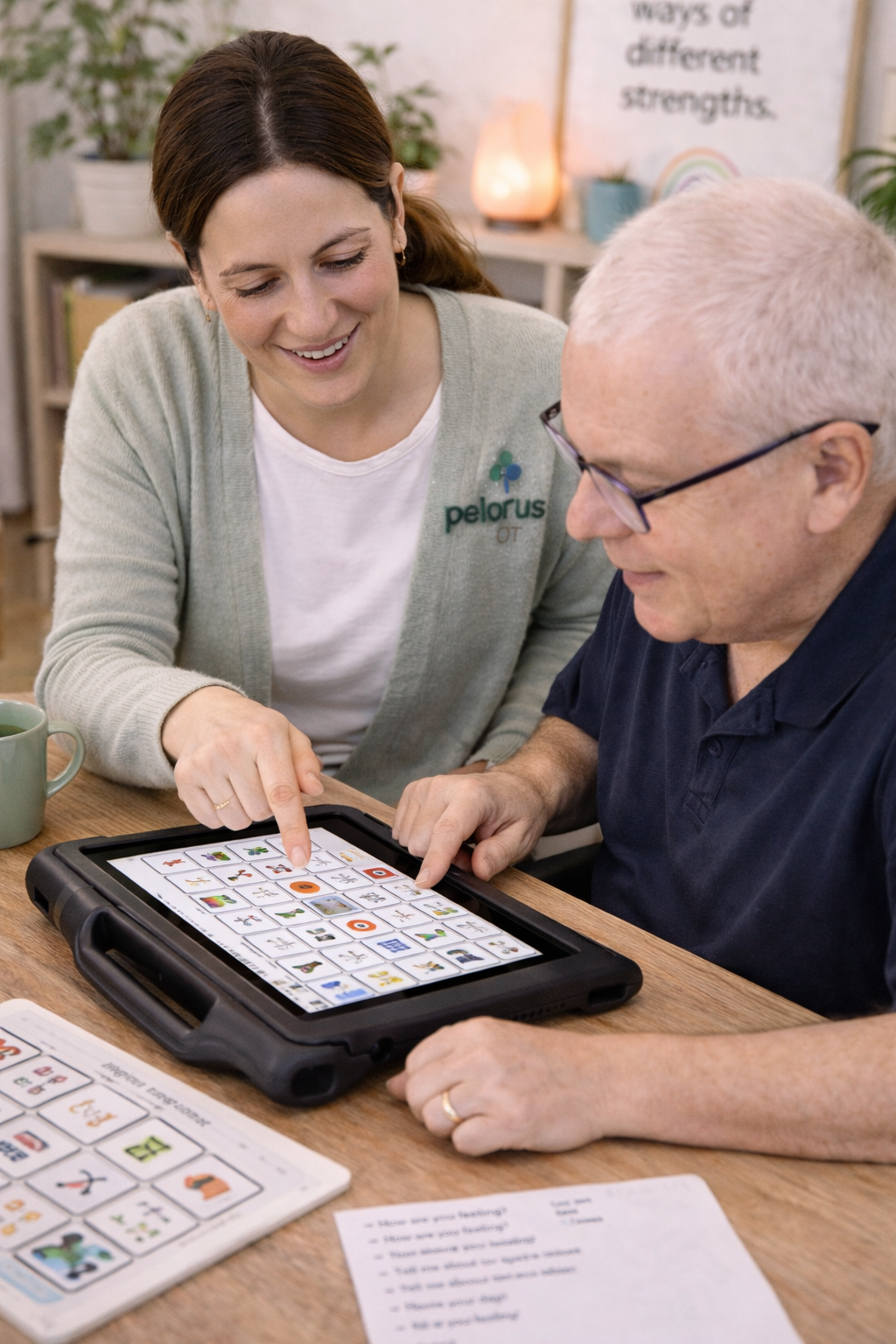
- Trialling different AAC systems and devices
- Prescription of the most suitable option
- Training for the individual and their support network
AAC may include:
- Speech generating devices
- Communication apps on tablets or iPads
- Picture-based systems
- Low-tech options such as communication boards or books
AAC can be used alongside speech or as a primary way to communicate.
What does the process involve?
We take a person-centred approach to ensure the communication system fits the individual and their everyday environments.
The process may include:
- Understanding current communication methods and preferences
- Trialling different AAC options
- Observing communication in real-life contexts
- Collaborating with families, carers, and support teams
- Providing recommendations and support for funding where required
We aim to create a low-pressure, supportive environment, where individuals can explore communication options in ways that feel comfortable and empowering.
Who is this for?
An AAC Assessment can support individuals across the lifespan who may benefit from additional or alternative ways to communicate.
This may include:
- Autism
- Cerebral palsy
- Intellectual disability
- Motor neurone disease
- Stroke or brain injury
- Progressive neurological conditions
- Complex communication needs
AAC is not a last resort. It is a valid and effective way to support communication at any stage.
How AAC Support Helps
AAC support is about increasing access to communication, choice, and participation.
It does not replace existing communication. Instead, it expands communication options through a structured AAC Assessment, which helps identify the most suitable tools and strategies for each individual.
AAC can support individuals to:
- Express needs, wants, and preferences
- Share thoughts, ideas, and emotions
- Participate in conversations and relationships
- Increase independence and autonomy
- Engage more fully in everyday life
Our Approach
At Pelorus OT, our AAC approach is neuro-affirming, strengths-based, and person-centred.
We recognise that there is no single “right” way to communicate. Our role is to support each individual to communicate in ways that feel natural and meaningful to them.
We focus on:
- Respecting communication preferences and autonomy
- Supporting multiple ways to communicate
- Avoiding pressure to replace speech
- Creating real-life, meaningful communication opportunities
- Working closely with families and support teams
What you will receive
Following the assessment and trials, you will receive clear and practical guidance to support next steps.
You will receive:
- A comprehensive AAC assessment report
- Recommendations for the most suitable system or device
- Support for funding applications if required
- Training and guidance for implementation