
Sensory Breaks for Kids: How to Improve Focus and Regulation
Many parents and teachers notice that children can have difficulty focusing, sitting still, or completing tasks, especially during schoolwork or structured activities. You might find yourself constantly reminding your child to “pay attention,” only to see them become distracted, restless, or overwhelmed within minutes.
In many cases, this isn’t about behaviour or motivation – it’s about how a child’s nervous system is processing and responding to sensory input throughout the day.
One simple and highly effective strategy that can support focus and regulation is the use of sensory breaks. When used at the right time and in the right way, these short breaks can help children reset, re-engage, and participate more successfully in daily activities.
Table of Contents
What Are Sensory Breaks for Kids?
Sensory breaks for kids are short, structured pauses during the day that provide the body with the input it needs to stay regulated, focused, and ready to engage in daily tasks.
Rather than expecting children to maintain attention for long periods, sensory breaks recognise that many children benefit from opportunities to reset their nervous system. For some children, particularly those with sensory processing differences, maintaining focus can be effortful.
These breaks are often used as part of a broader sensory diet, where Occupational Therapists recommend specific strategies across the day to support a child’s regulation, attention, and participation.
Why Sensory Breaks Can Improve Focus in Children
Many parents search for ways to improve focus in children, especially when they notice their child has difficulty concentrating, loses attention quickly, or struggles to sit still.
From a sensory perspective, focus is closely linked to how regulated a child’s body feels. When a child is under-aroused (tired, disengaged) or over-aroused (overwhelmed, anxious), their ability to concentrate is reduced.
Sensory breaks help bring the nervous system back to an optimal level of alertness. This is why a short, well-timed break can often be more effective than repeatedly asking a child to “focus” or “pay attention.”
Recognising When a Child May Need a Sensory Break
Children rarely say, “I need a sensory break.” Instead, their behaviour often communicates it.

Many parents describe concerns such as their child having difficulty focusing, not listening, or not being able to sit still, particularly during homework or classroom tasks. These behaviours are often misunderstood as lack of effort or motivation, but they can reflect underlying sensory needs.
You might notice a child becoming increasingly restless, fidgeting constantly, or leaving their seat frequently. Some children may rush through tasks, while others may avoid them altogether because sustaining attention feels too difficult.
At other times, a child may appear tired, disengaged, or “zoned out.” Parents often describe this as their child daydreaming or struggling to follow instructions.
In some situations, sensory needs present as emotional responses. A child who becomes easily overwhelmed, frustrated, or prone to meltdowns during tasks may be experiencing sensory overload rather than behavioural defiance.
Busy environments can also be challenging. A child may cover their ears, withdraw, or become irritable in noisy or crowded settings. Transitions – such as moving from play to homework – can also trigger difficulty, as they require additional regulation.
Recognising these signs early allows sensory breaks to be introduced proactively, helping the child reset before frustration builds.
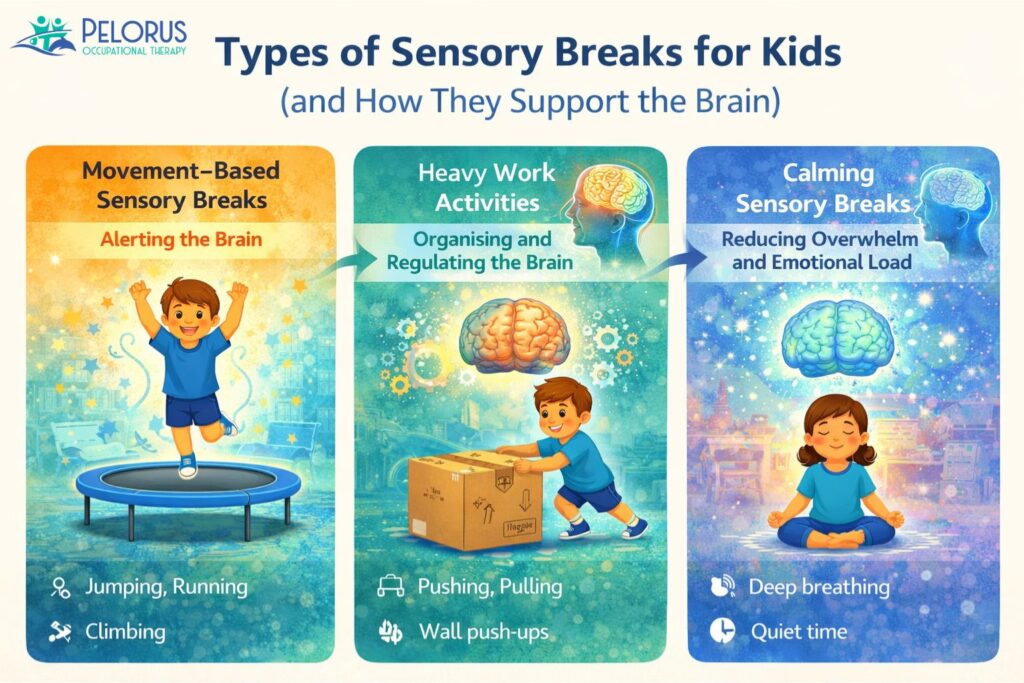
Types of Sensory Breaks for Kids (and How They Support the Brain)
Sensory breaks are most effective when they are matched to what the child’s brain and body need in that moment. Many parents search for “activities to improve focus in children” or “how to calm an overwhelmed child”, but understanding how different activities affect the brain is key.
Movement-Based Sensory Breaks (Alerting the Brain)
Movement-based activities such as jumping, running, or climbing are particularly helpful when a child appears tired, distracted, or disengaged.
These activities stimulate the vestibular system, which plays an important role in alertness and attention. Movement increases activation in the brain, helping improve focus, processing speed, and readiness to learn.
For example, a child who is struggling to concentrate on homework may benefit from a short burst of movement before returning to the task with improved attention.
Heavy Work Activities (Organising and Regulating the Brain)
Heavy work activities involve pushing, pulling, lifting, or carrying. These provide deep pressure input to the muscles and joints and are particularly effective for children who can’t sit still, feel constantly restless, or struggle with regulation.
This type of input activates the proprioceptive system, which has a calming and organising effect on the brain. It helps improve body awareness, reduce excessive movement, and support sustained attention.
For example, a child who is frequently fidgeting or leaving their seat may benefit from wall push-ups or carrying objects before returning to a seated activity.
Many of these strategies are explored further in our Heavy Work Activities article, as they are one of the most effective sensory tools for regulation.
Calming Sensory Breaks (Reducing Overwhelm and Emotional Load)
Calming sensory breaks are useful when a child feels overwhelmed, anxious, or overstimulated.
These activities support the parasympathetic nervous system, helping the body move from a state of stress to a more regulated state. Strategies such as deep breathing, quiet time, or gentle sensory input can help reduce emotional intensity.
For example, a child who becomes frustrated during tasks or overwhelmed in busy environments may benefit from a short calming break before re-engaging.
You can explore a range of these strategies in our Sensory Activities for Kids article.
Hypothetical Examples: How Sensory Breaks Can Help
To better understand how sensory breaks can support children, it can be helpful to consider practical examples.
Example 1: Child with ADHD (Hypothetical)
A 7-year-old child with ADHD struggles to stay seated during classroom tasks and often loses focus within minutes. Introducing short sensory breaks, such as wall push-ups or carrying books, helps regulate their energy levels. Over time, the child is better able to remain seated and complete tasks.
Example 2: Child on the Autism Spectrum (Hypothetical)
An 8-year-old child on the autism spectrum becomes overwhelmed in busy environments and during transitions. Providing calming sensory breaks, such as quiet space or deep pressure activities, helps reduce sensory overload and supports smoother transitions.
Example 3: Child with Sensory Processing Challenges (Hypothetical)
A 6-year-old child who constantly seeks movement finds it difficult to sit for homework. Scheduling short movement breaks, such as jumping or obstacle activities, helps meet their sensory needs and improves focus during seated tasks.
Sensory Break Ideas for Home and School (With Real-Life Application)
Sensory breaks can be integrated naturally into both home and school routines.
In the classroom, simple strategies such as wall pushes, chair-based movements, or carrying materials can support attention without disrupting learning. These short sensory breaks can help children stay engaged and improve participation.
At home, many everyday activities can serve as sensory breaks. Helping carry groceries, pushing a laundry basket, or engaging in active play can provide meaningful sensory input.
For example, if a child struggles to complete homework and becomes restless within minutes, introducing a short sensory break – such as jumping or pushing against a wall – can help reset their system. When they return, they are often more able to focus and complete the task.
Over time, these small adjustments can significantly improve a child’s ability to engage in daily routines.
When and How to Use Sensory Breaks
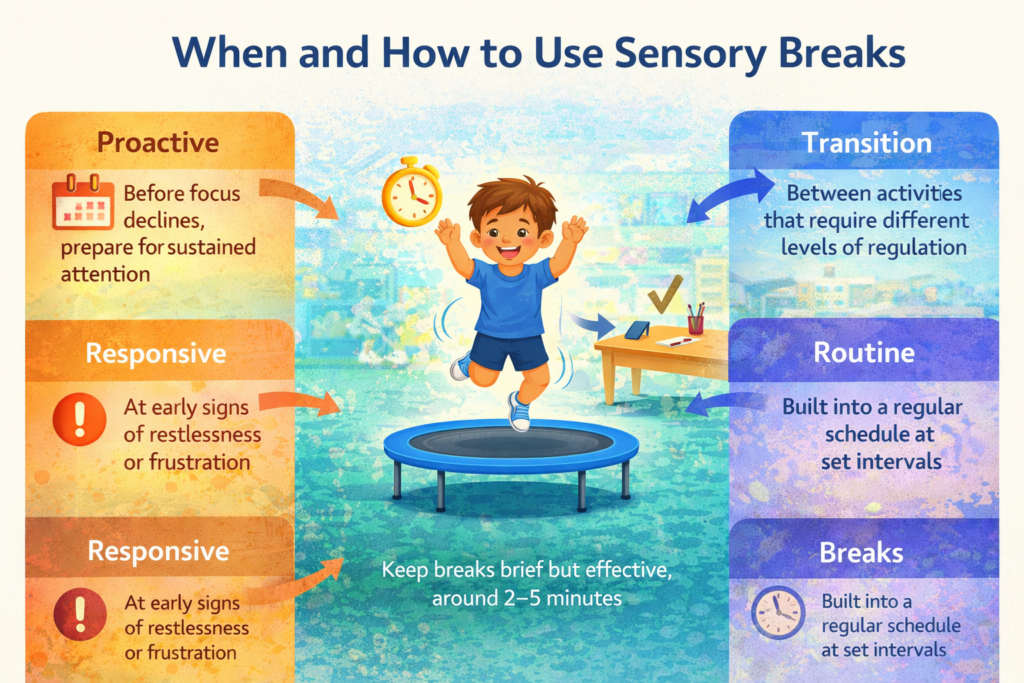
Timing plays an important role in how effective sensory breaks are. Many parents notice that their child has difficulty focusing after a short period, or that they lose attention quickly during tasks such as homework or classroom work. In these situations, introducing a sensory break before focus declines can be far more effective than waiting until frustration builds.
Sensory breaks can be used proactively and responsively. Proactively, they may be scheduled before activities that require sustained attention – such as schoolwork, writing tasks, or structured learning. This helps prepare the child’s body and brain for engagement. Responsively, they can be introduced when early signs of dysregulation appear, such as restlessness, disengagement, or increased frustration.
Transitions are another key moment where sensory breaks can be helpful. Moving from one activity to another – such as from playtime to homework or from recess to classroom learning – requires the child to shift both physically and mentally. A short, well-chosen sensory break during these moments can support smoother transitions and reduce resistance.
Some children benefit from having sensory breaks built into their routine at regular intervals, particularly when tasks require sustained concentration. For example, a child who struggles to sit still during homework may benefit from a short break every 20–30 minutes. Over time, this structured approach can improve endurance and reduce the likelihood of overwhelm.
In most cases, sensory breaks are most effective when they are brief and clearly defined. Keeping them to around two to five minutes helps the child reset without losing momentum. Pairing the break with a clear expectation – such as returning to the task afterwards – helps maintain consistency and supports the development of self-regulation skills.
How Sensory Breaks Fit Into a Sensory Diet
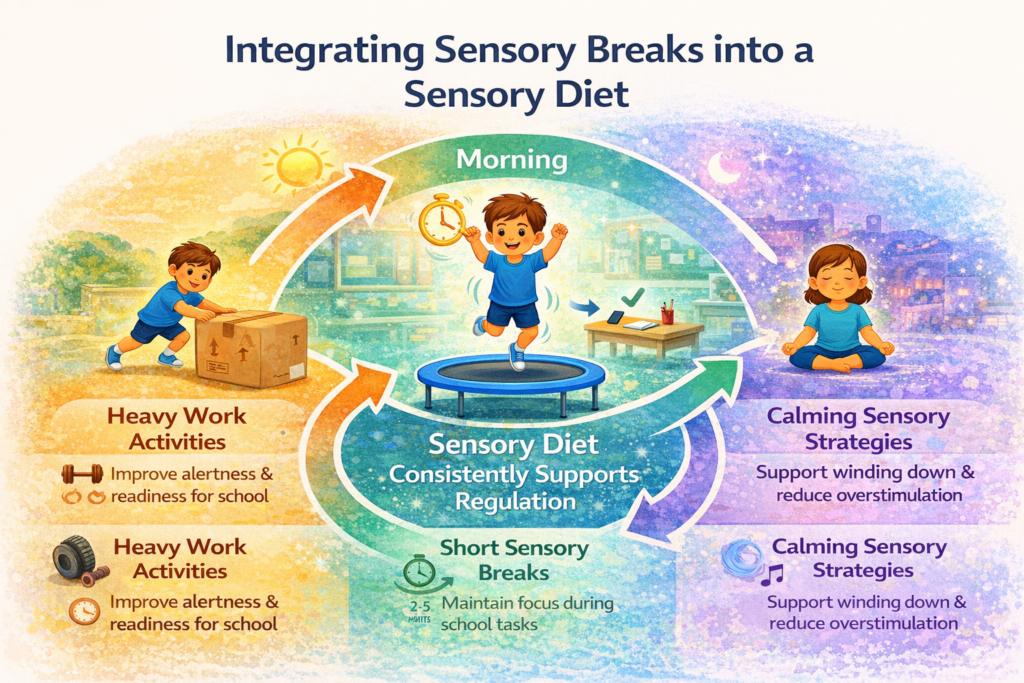
Sensory breaks are most effective when they are not used in isolation, but as part of a consistent and individualised approach to regulation.
A sensory diet refers to a carefully planned set of activities and strategies used throughout the day to support a child’s sensory needs. Rather than reacting only when challenges arise, a sensory diet provides regular input to help the child maintain a more balanced and regulated state.
Within this framework, sensory breaks act as key moments of support. They help bridge the gap between different parts of the day – such as transitioning from high-energy activities to focused tasks, or from stimulating environments to quieter ones. By providing the right type of sensory input at the right time, these breaks help prevent both under-arousal (low energy, disengagement) and over-arousal (overwhelm, emotional distress).
For example, a child may benefit from movement or heavy work activities in the morning to support alertness and readiness for school, followed by short sensory breaks during classroom tasks to maintain focus. Later in the day, calming sensory strategies may be more appropriate to support winding down and reducing overstimulation.
This is where understanding different types of input becomes important. Movement-based activities can help improve alertness, heavy work activities can support organisation and body awareness, and calming sensory activities can help reduce stress and emotional load. When combined thoughtfully, these strategies create a more predictable and supportive environment for the child.
A well-structured sensory diet is always individualised. What works for one child may not work for another, which is why observing patterns – such as when a child struggles most with focus or becomes overwhelmed – can help guide the timing and type of sensory breaks used.
By integrating sensory breaks into a broader sensory diet, children are more likely to experience consistent regulation, improved attention, and greater participation across home, school, and community environments.
How Pelorus OT Can Help
While sensory breaks can be highly effective, some children benefit from more individualised support to fully understand their sensory needs and develop strategies that work consistently across home and school environments.
At Pelorus OT, our therapists work closely with families, educators, and support teams to create personalised approaches tailored to each child. This may include developing a structured sensory diet that supports regulation throughout the day, identifying the most effective heavy work activities to improve body awareness and attention, and selecting appropriate sensory activities that align with the child’s needs.
We focus on practical, real-life strategies that can be easily implemented in everyday routines – whether that’s improving focus during classroom tasks, supporting smoother transitions, or reducing overwhelm in busy environments.
Our goal is to support children to feel more regulated, confident, and able to participate meaningfully in their daily activities.
When used consistently and as part of a broader approach – including strategies such as a well-planned sensory diet, targeted heavy work activities, and a range of sensory activities – these short breaks can make a meaningful difference in how children engage with learning and everyday life.
By understanding your child’s unique needs and providing the right support at the right time, you can help them feel more organised, calm, and ready to participate with confidence.
Get Support for Your Child
If your child is experiencing ongoing challenges with focus, attention, or becoming easily overwhelmed, the right support can make a meaningful difference.
At Pelorus OT, we provide personalised Occupational Therapy services to help children develop practical strategies for regulation, participation, and independence across home and school environments.
If you would like to explore how we can support your child, you can complete our referral form here:
Alternatively, feel free to reach out to our team to discuss your child’s needs and the most appropriate next steps.